Fit and sizing
Buying UK sizes by measurement instead of by the label
Buy UK clothing and shoe sizes by measurement: what the BS EN 13402 size system is based on, the four numbers to record once, and how to cost ordering two sizes.

A size 12 is not a measurement. It is a label chosen by a brand, and two garments carrying it can differ by several centimetres at the waist. That is why buying by label produces returns, and why buying by measurement produces clothes you keep.
This guide sets out the four numbers worth recording, how to use a seller's own size chart rather than a general conversion table, and what ordering more than one size actually costs you in time and in money that is temporarily not yours.
What the European size system is actually based on
There is a published standard for this. BS EN 13402-1, Size designation of clothes — Terms, definitions and body measurement procedure, was published on 15 May 2001 and is listed by BSI as current and under review. It defines body dimensions for garments, specifies a procedure for measuring the body, and gives pictograms for use on garment labels.
The important point is in the title: the system is built on body dimensions, not on garment dimensions. A label designating a chest or waist measurement is telling you who the garment is meant to fit, which is a statement you can test with a tape measure. A number such as 12 on its own carries no such statement.
Because the standard is voluntary rather than a legal requirement for clothing sold in the UK, you will find all three conventions in the same wardrobe: a body-measurement label, a national size number and a letter size. Treating the measurement as the real information and the number as a shelf code resolves most of the confusion.
| On the label | What it is | How far to trust it |
|---|---|---|
| Bust 92 cm / Waist 74 cm | A body measurement designation of the kind BS EN 13402 describes | Directly comparable with your own tape measure |
| Size 12 | A national size code chosen by the brand | Comparable only within that brand |
| M | A letter size covering a range | Useful for jersey and knitwear, weak for tailoring |
| UK 6 / EU 39 | A shoe size pair | Compare against the maker's own chart in millimetres, not between brands |
Take four measurements once and write them down
Four numbers cover almost everything: bust at the fullest point, natural waist at the narrowest, hip at the fullest point, and inside leg from crotch to floor without shoes. Take them over the underwear you would wear with the garment, with the tape level and snug but not pulled tight.
Add two more for shoes and outerwear and the set is complete: foot length in millimetres, measured standing on paper at the end of the day when the foot is largest, and shoulder-to-wrist for sleeve length. Six measurements take about 10 minutes once, and then they are good for a year or more unless your weight changes.
Store them somewhere you can reach from a phone. The failure mode is not that people do not know how to measure; it is that the tape is in a drawer at home while the decision is being made on a train.
- Bust, at the fullest point with the tape level across the back
- Natural waist, at the narrowest point, found by bending to one side
- Hip, at the fullest point, usually 20 to 22 cm below the waist
- Inside leg, crotch to floor, standing barefoot against a wall
- Foot length in millimetres, measured at the end of the day on paper
- Shoulder to wrist, with the arm slightly bent
Shoes: measure the foot, then read that maker's own chart
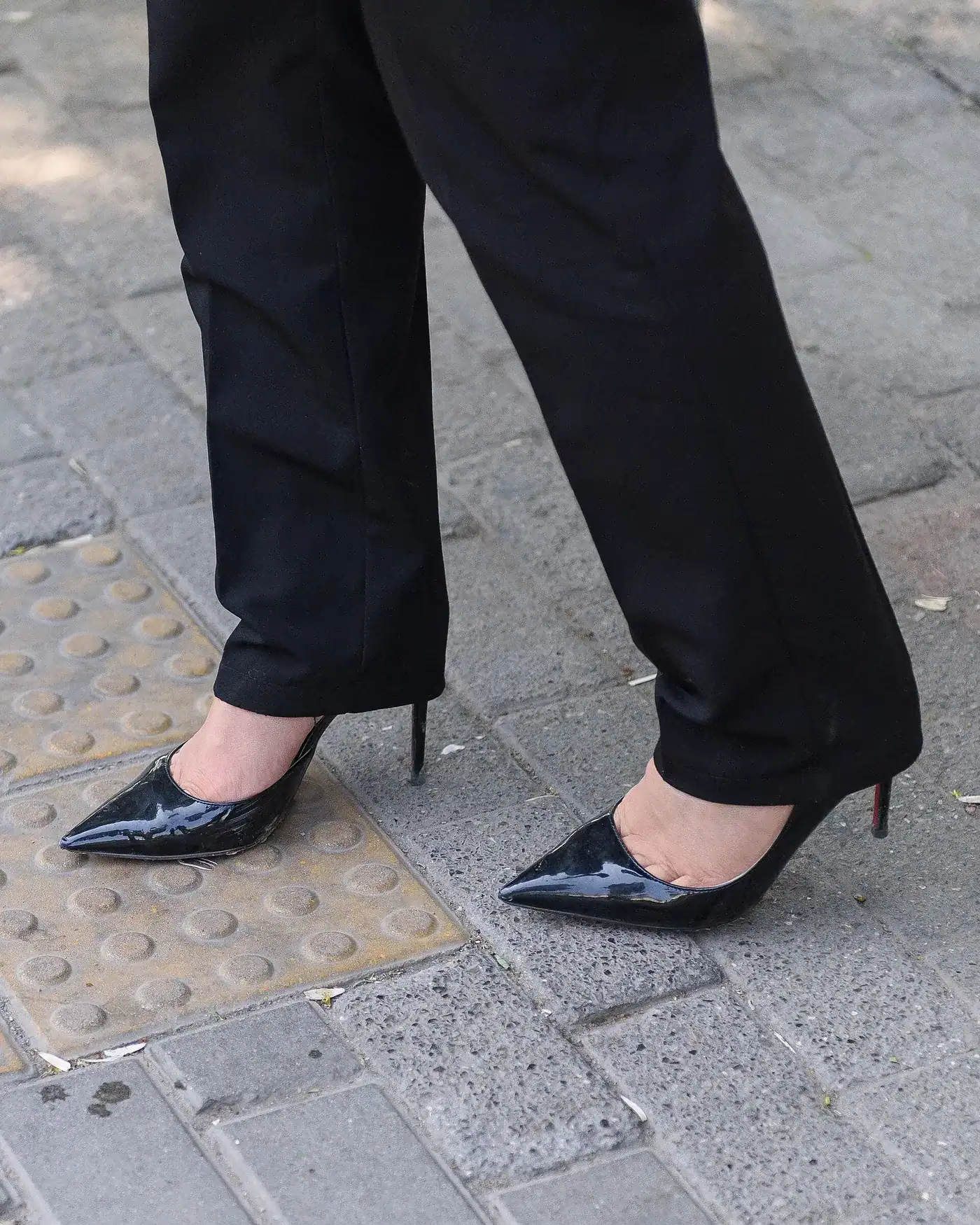
Shoe sizing varies more between makers than clothing does, because the last — the form the shoe is built around — differs in width and depth as well as length. A foot that measures 245 mm may take one size in a round-toe boot and a different one in a pointed court, from the same brand in the same season.
The reliable method is to measure the foot in millimetres and look for the maker's own chart, which many publish in millimetres rather than only in UK numbers. Where only a national size is published, order one size and treat the second as an experiment rather than as insurance.
Width is the measurement most people never take and the one that ends up causing the return. A court shoe that is the right length but too narrow across the ball of the foot will not become wearable, and the cost-per-wear arithmetic on a shoe worn 6 times instead of 180 is brutal: a £75 pair worn 60 times a year for 3 years is £0.42 a wear, and the same pair abandoned after 6 wears is £12.50 a wear.
| How often you actually wear them | Wears over 3 years | Cost per wear |
|---|---|---|
| 3 days a week, 20 weeks a year | 180 | £0.42 |
| Once a month | 36 | £2.08 |
| Six times, then never again | 6 | £12.50 |
Each cell is £75 divided by the wears in the middle column. The point is the spread: fit, not price, is what moves this figure.
Ordering two sizes is lawful, and it has a price
For distance sales, GOV.UK's guidance for traders states that a refund must be offered if the customer says within 14 days of receiving the item that they want to cancel, and that the refund must be made within 14 days of the item being received back. Ordering two sizes and returning one is therefore a normal use of that right rather than an abuse of it.
The cost is in cash flow and in time. Two garments at £45 each ties up £90, and in the worst case that money is out of your account for up to 28 days: 14 days while the parcel sits at home, then 14 days from the seller receiving it back. Doing that on three items at once is £270 held for four weeks.
The exclusions are worth knowing before you plan around the right. The same guidance lists personalised or custom-made items, perishable goods, newspapers and magazines, unwrapped CDs, DVDs and software, and sealed items that cannot be returned once opened for health or hygiene reasons.
Putting it together at the point of decision
At the moment of buying, the sequence is short: open your six measurements, open the seller's own chart, compare like with like, and only then look at the size number. Where a chart gives a range, take the garment that puts your measurement in the middle of the range rather than at the edge.
Across a year that habit is worth more than any single purchase. Average weekly household expenditure in the UK was £676.60 in the financial year ending 2025 according to the ONS, and the richest fifth of households increased clothing and footwear spending by £5.30 a week, or 23%, between the financial years ending 2023 and 2025. Buying by measurement is how that money turns into clothes that get worn.
Before you buy
- Take six measurements once: bust, waist, hip, inside leg, foot length in millimetres and shoulder to wrist
- Save them where you can read them from a phone while standing in a shop
- Use the seller's own chart in centimetres or millimetres rather than a general conversion table
- Where a chart gives a range, choose the size that puts you in the middle of it
- Measure feet at the end of the day, standing, and work from the longer foot
- If you order two sizes, be ready for up to 28 days before the refund for the second one clears
- Check whether the item is in one of the excluded categories before relying on the cancellation right
Questions readers ask
- Why does the same size fit differently in two shops?
- Because a national size number is a brand's own code rather than a body measurement. BS EN 13402-1 describes a system based on body dimensions and a defined measuring procedure, but using it is voluntary for clothing sold in the UK. Where a brand publishes a chart in centimetres you can compare directly; where it only gives a number, you can only compare within that brand.
- When is the best time of day to measure my feet?
- At the end of the day, standing, with the weight on the foot being measured. Feet swell over a day and under load, so a morning measurement taken sitting down will read short and lead to shoes that fit in the shop and not at 6pm. Measure both feet and work from the longer one, since a difference of several millimetres is common.
- Is ordering three sizes to find the fit unreasonable?
- It is permitted for distance sales, but cost it first. Three items at £45 is £135 held, potentially for up to 28 days, and the return journeys are time you spend. Taking six measurements once and reading the seller's chart usually reduces the order to one or two items, which is cheaper in both money and effort.
- Do the same rules apply to something I bought in a shop?
- No. The 14-day cancellation right in GOV.UK's guidance applies to distance sales. In-store purchases rely on the shop's own returns policy for a change of mind, and on your separate statutory rights if the item is faulty. That is a reason to take your measurements with you rather than planning to return.
- Which measurement matters most for a tailored jacket?
- Bust and shoulder-to-wrist, in that order. Waist can be altered on most tailoring, hems can be shortened, and sleeves can usually be taken up; a shoulder that is wrong is expensive to alter and often cannot be rescued. Buy for the measurement that cannot be changed and alter the ones that can.
Sources
- BSI — BS EN 13402-1:2001, Size designation of clothes: terms, definitions and body measurement procedure — checked 2026-11-03
- GOV.UK — Accepting returns and giving refunds: the law (14 days to cancel, 14 days to refund, excluded goods) — checked 2026-11-03
- Office for National Statistics — Family spending in the UK: April 2024 to March 2025 — checked 2026-11-03
Advertising is not enabled on this site yet. When it is, ads will be labelled and kept visually separate from the guides.